Service

Modernization &
Platform Development

Service Overview

Most construction companies are running technology stacks that were built for a smaller, simpler version of the business. Spreadsheets that started as a workaround and became the system of record. Software that nobody is fully using. Platforms that were selected five years ago and haven't been evaluated since. The cost of that mismatch compounds every year.
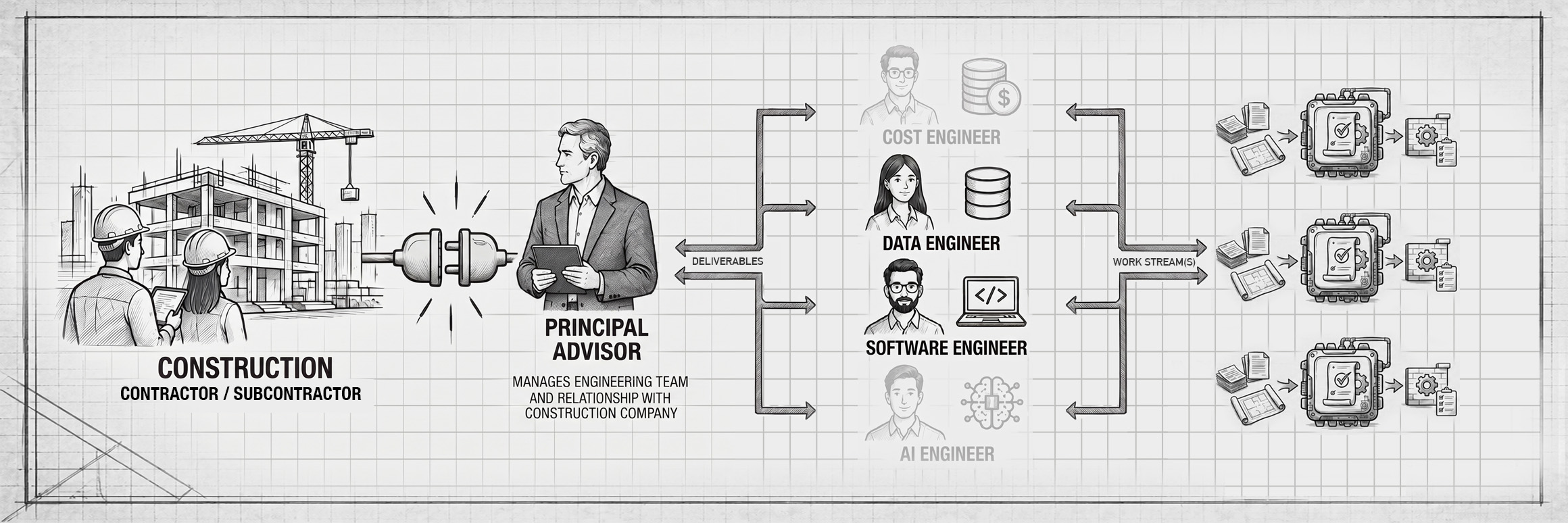
Modernization & Platform Development

Modernization & Platform Development is the workstream that addresses the gap between where your technology stack is and where it needs to be — not by replacing everything at once, but by sequencing the changes that recover the most operational capacity with the least disruption. We assess, recommend, migrate, configure, and build — in the order that makes sense for your operation.

A Red Grey Principal Advisor owns this workstream for the term of your retainer. They staff it internally across software engineering, data engineering, and construction technology expertise. You don't manage the migration or the build. You define the business requirements, approve the platform selection, and review working deployments before they go live.

Outcomes you can measure. Every month.

Every Engagement begins with a technology stack assessment against your operational requirements and construction industry best practices. At the end of Discovery, you have a gap analysis and a modernization roadmap. Every month after that, the outcome review measures platform adoption, replaced workarounds, and eliminated legacy processes against the baseline.

🏗️
Right Platform for the Operation
Technology selected against your actual workflows, volume, and team size — not because a salesperson called at the right time. Platform decisions documented with the reasoning so the next evaluation starts from a real baseline.
📤
Clean Migration
Data migrated from legacy systems with validation at every step. Historical records preserved in the format the new platform requires. No data lost in the transition. No parallel-run period that lasts two years.
⚙️
Configured, Not Just Installed
Platforms configured against your workflows, not the vendor's demo setup. Cost code structure, project templates, approval workflows, and user roles set up before the first real job goes in.
👥
Staff Actually Using It
Adoption instrumented and measured. Training designed around what your field and office team actually do, not generic vendor training. Shadow spreadsheets identified and retired.
🔄
Eliminated Legacy Processes
Workarounds, manual processes, and shadow systems that exist because the old platform couldn't do something replaced with the new platform's native capability. The list of exceptions shrinks every month.
📐
Architecture That Scales
Platform and integration choices made with the next two to three years in mind. Not overbuilt for where you are. Not underbuilt for where you're going. Documented so the next person who inherits the stack understands why decisions were made.

Common workstreams under this service.

These are the most common workstreams we build under Modernization & Platform Development. The specific platforms and migration paths depend on your current stack and your operational requirements. Discovery defines the assessment and the roadmap.

Technology Stack Assessment & Platform Selection ⚙
→ Evaluate every tool in your current stack against your operational requirements.
→ Your team size, your volume, and construction industry best practices.
→ Identify the gaps, the overlaps, and the platforms that are no longer the right fit.
→ Deliver a platform selection recommendation with documented rationale and a replacement roadmap.
Platform Migration ⚙
→ Migrate from legacy platforms to modern replacements with data validation at every step.
→ Define the migration sequence, the data mapping, the cutover plan, and the rollback protocol.
→ Deliver a clean migration with historical data intact and no parallel-run period that drags on.
Platform Configuration & Workflow Setup ⚙
→ Configure new or underutilized platforms against your actual workflows.
→ Cost code structure, project templates, approval workflows, document naming conventions, user roles, and notification rules.
→ Deliver a configured platform your team can use on day one without a two-week learning curve.
Construction Technology Evaluation ⚙
→ Assess emerging construction technology platforms.
→ Estimating, BIM coordination, field management, safety, quality, against your specific use cases and integration requirements.
→ Deliver a structured evaluation with scoring against your criteria, not vendor marketing materials.
Legacy System Decommission ⚙
→ Build the plan to retire platforms your team has outgrown or replaced.
→ Preserve historical data in an accessible format.
→ Define the cutover date, communicate the change to staff, and close the old system cleanly.
→ Deliver a decommission that doesn't leave ghost logins and orphaned data behind.
Adoption & Change Management ⚙
→ Instrument adoption on newly deployed platforms.
→ Define what healthy usage looks like for each role.
→ Identify the staff who are falling back to old workflows and why.
→ Deliver a monthly adoption report that tells you where the change is sticking and where it needs reinforcement.

From the first call to retained delivery. Here is exactly how it works.

Every engagement follows the same sequence. No surprises. No ambiguity about what you're agreeing to before you agree to it.

01
Scoping Call — 30 Minutes
You describe the challenge. We ask the questions that tell us where the problem actually lives. By the end of the call we tell you which workstream addresses it, what Discovery looks like for this specific problem, and what the first 30 days produce. You leave with a verbal scope and a clear picture of what comes next. No pitch deck. No follow-up sales cycle.
02
Mutual Non-Disclosure Agreement
Before we review any project data, financials, or internal systems, both parties execute a Mutual NDA. This is a standard two-way confidentiality agreement — it protects your data and our methodology equally. We send it, you review it with your counsel if needed, and we execute before anything substantive is shared. Typical turnaround is one to two business days.
03
Master Service Agreement
The MSA governs the overall relationship — intellectual property ownership, liability, payment terms, dispute resolution, and termination provisions. It is executed once and covers every Statement of Work issued under it. We provide the standard Red Grey MSA. You review it, propose any changes, and we agree before any work begins. The MSA is the legal foundation. The SOW is the operational scope.
04
Discovery Engagement — 30 Days
Month one is always Discovery. For Modernization, Discovery is a 30-day assessment of your current technology stack against your operational requirements and construction industry best practices. We evaluate every platform in use, document the workflows it supports, assess the degree to which it's actually being used, and identify the gaps it's not covering. We benchmark against what firms at your revenue level and operational complexity are running. At the end of 30 days, we deliver a written findings report: a complete stack assessment, a gap analysis, and a phased modernization roadmap.
05
Statement of Work
The SOW is issued after Discovery findings are reviewed and accepted. It defines the specific workstreams to be delivered, the success metrics for each, the systems in scope, the communication cadence, and the term. It is signed before month two begins. The SOW is not a proposal — it is the execution document built directly from the Discovery findings. If the Discovery findings don't support a particular workstream, it doesn't appear in the SOW.
06
Retained Term — Monthly Delivery
The retainer runs on a monthly cadence from SOW execution. Weekly working sessions move each workstream forward. Monthly outcome reviews measure what moved against the baseline established in Discovery. Every month produces a working artifact — a tool, integration, workflow, or process that exists in your operation. Your Principal Advisor signs off on every deliverable. You approve outcomes and success metrics. You do not manage the engineering work.
07
Scaling Engagements — Scope Change Engagement
The number of concurrent Engagements is set at contract signing and fixed for the term. If your priorities shift mid-term and you need to add or remove a workstream, that requires a Scope Change Engagement — a structured rescoping process that produces updated findings, a revised SOW, and a clear transition plan. The Scope Change Engagement is priced at your original Discovery rate and billed in addition to your current monthly retainer. Changes take effect at the start of the next engagement cycle after the Scope Change Engagement is complete. At contract renewal, your Engagement count can be adjusted with no Scope Change Engagement required.
08
Runbook & Adoption Handoff
Every workstream closes with a Runbook & Adoption Pack. The runbook documents how the tool or workflow operates, who owns which step, how data quality is maintained, and how to know it is being used. The adoption pack covers staff training, role-level instructions, and what a healthy versus degraded state looks like. The handoff is documented, reviewed, and signed off before the Engagement is marked complete. This is not a PDF filed away. It is the operating manual for the artifact we built.

How we access your systems. What we touch. What we don't.

This work requires access to your systems and data. We take that access seriously. Here is exactly how it works.

What We Access
Read access to your current platforms — ERP, PM software, accounting tools, field applications, and document management systems. We typically need credentials to assess configuration, usage, and data quality. We do not need production data during the assessment phase; a walkthrough of the live system with your team is sufficient for most evaluation work.
How Access Is Granted
We request the minimum permission set required for the workstream in scope. Where possible, we use read-only credentials for data review and analysis work. Write access is requested only for the specific systems we are building into. We do not request admin or owner-level access unless the workstream explicitly requires it — and if it does, that is documented in the SOW and requires your written approval before access is granted.
Credential Management
Credentials are stored in a dedicated password manager, never in email or shared documents. Access is provisioned to the named Red Grey engineer assigned to the workstream. Access is revoked at the end of the Engagement or immediately on request. We do not retain credentials after an Engagement closes. If you prefer to provision temporary access per working session, we accommodate that without adding friction to the delivery cadence.
Data Handling
Your data does not leave your systems unless a specific integration or export is part of the workstream scope. Working files used during analysis are stored in a Red Grey client workspace, not in personal accounts or shared drives accessible outside the Engagement team. The NDA governs confidentiality. The MSA governs data ownership — your data is yours. We build on it. We do not retain it.
Communication Security
All client communication runs through a dedicated Slack workspace. Red Grey maintains its own workspace with per-client channels. Your team connects via Slack Connect — you see your channel only, not any other client's. Sensitive documents are shared via a secure link, not as email attachments. We do not use SMS for anything substantive. We do not discuss project data on open channels.
Access Offboarding
When an Engagement ends — whether at term, by mutual agreement, or by early termination — we initiate access offboarding within 24 hours of the final engagement date. All credentials are revoked, all working files are either returned to you or deleted per the offboarding checklist in the SOW, and a written confirmation is issued. You do not need to chase us for this.

Every engagement begins with a 30-day Discovery.

Discovery is not a consulting engagement you buy hoping it leads somewhere. It is month one of a retained workstream. It produces a written findings report. It becomes the foundation of your SOW. If the findings don't support moving forward, you have a clear picture of why and what to do about it — and you are not locked into anything.

Modernization & Platform Development — Discovery Engagement

30 days. A complete stack assessment and a sequenced modernization roadmap.

The Discovery Engagement for Modernization covers three areas: current stack assessment and gap analysis, platform benchmarking against construction industry standards for your operation size, and modernization roadmap sequencing. We walk every platform in use, assess configuration and adoption, and map the workflows each tool supports. We benchmark what you're running against what firms like yours are running. At the end of 30 days, you have a clear picture of what to replace, what to reconfigure, what to retire, and in what order.

Written findings report — complete technology stack assessment and gap analysis
Platform benchmarking — how your stack compares to industry standards for your size
Adoption assessment — which tools are being used, which aren't, and why
Modernization roadmap — what to replace, reconfigure, and retire in what sequence
Platform selection shortlist for any identified replacement needs
Baseline metrics — platform adoption rates and manual process counts we'll measure against

Discovery-Only Hold Policy. If you complete a Discovery Engagement and do not immediately convert to a retainer, your findings remain valid for 90 days. If you return within that window, you convert directly to a retainer with no additional Discovery required. After 90 days, a new Discovery Engagement is required before a retained term begins.

Not sure which service to start with? The scoping call is the right place to figure that out. Tell us what you're dealing with and we'll tell you where to start.

Ready to bring your technology stack into alignment with your operation?

30-minute scoping call. Tell us what you're running and we'll tell you where the gaps are.