Service

Cost Engineering &
Margin Management

Service Overview

Cost Engineering & Margin Management is a retained workstream that installs a functioning cost intelligence system into your operation. Not a report. Not a one-time audit. A set of working tools, workflows, and data connections that give your team real numbers before a job goes sideways, and keep them there every month.
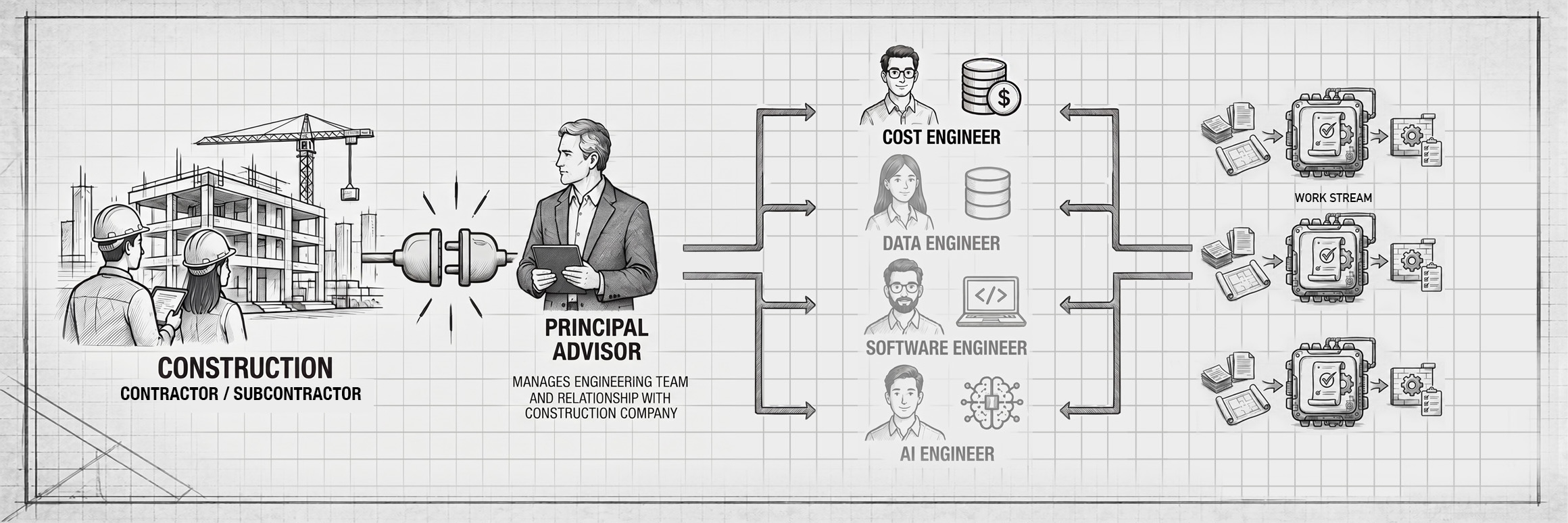
Cost Engineering & Margin Management

The work starts in estimating and traces margin through every phase, buyout, procurement, field execution, change orders, billing, and closeout. Most of the margin lost on construction projects is lost in the details of those handoffs. We find those details, build the systems that capture them, and measure the result against your baseline every month.

This is not a consulting engagement that delivers a slide deck and walks away. A Red Grey Principal Advisor owns this workstream for the term of your retainer. They staff it internally across cost and data engineering. You approve the outcome and the success metrics. The artifact sits in your operation. The monthly review tells you what moved.

Outcomes you can measure. Every month.

Every Engagement begins with a baseline. At the end of month one, you have a written findings report that puts a number on the current-state problem. Every month after that, the outcome review measures what moved against that number. These are the categories where Cost Engineering workstreams consistently recover margin.

📐
Estimating Accuracy
Historical cost data replacing memory-based estimates. Bid-to-actual variance tracked by trade, crew, and site condition. Systematic cleanup of consistently wrong line items.
📋
Change Order Capture
Scope changes logged at the moment of direction, not weeks later. Change order workflow with cost and schedule impact attached. Recovery window preserved.
📊
Field-to-Forecast Loop
Field actuals flowing to office forecasts without manual re-entry. Cost-to-complete projections updated weekly. Problems visible at week two, not week eight.
🏗️
Buyout & Procurement
Buyout discipline that locks subcontractor and material pricing before installation-day cost exceeds bid-day cost. Procurement log with variance tracking against the estimate.
💳
Billing & AR Recovery
Pay applications submitted on time with documentation complete. Retainage tracked against closeout milestones. Aging AR with a collection workflow that doesn't wait for accounting to close.
🔒
Closeout & Retainage
Closeout documentation requirements set at project kickoff, not at substantial completion. Punch list management started 60 days before SC. Retainage freed faster.

Common workstreams under this service.

These are the most common workstreams we build under Cost Engineering & Margin Management. Not every engagement covers all of them. Discovery defines which ones are highest value for your specific operation. The workstream list is what gets built, handed off, and measured.

Bid-to-Actual Variance Analysis & Estimating Calibration ⚙
→ Pull historical bid data against actuals across completed jobs.
→ Identify the line items that consistently miss and by how much.
→ Rebuild the estimating model around your own production rates, not industry averages.
→ Delivers a calibrated unit cost library your estimators can actually use.
Field Actuals to Office Forecast Integration ⚙
→ Connect field production data (daily reports, foreman logs, timecard actuals) to the office cost model without manual re-entry.
→ Cost-to-complete updates weekly. Variance flags before they compound.
→ Delivers a live forecast your PM can update and your principal can trust.
Change Order & Scope Control Workflow ⚙
→ Build the workflow that captures scope direction the moment it happens.
→ Verbal, email, RFI — and converts it to a priced CO before the work is installed.
→ Track CO status against approval, payment, and schedule impact.
→ Deliver a CO log that holds up in a dispute.
Job Cost Reporting & Financial Visibility ⚙
→ Set up ERP or accounting system job cost categories that match the estimate structure.
→ Build custom reporting views your PM can run without waiting for accounting to close.
→ Define the cost-to-complete rule: any PM should be able to pull a current projection within 24 hours on any active job.
Buyout Log & Procurement Discipline ⚙
→ Build a buyout tracking log tied to the estimate.
→ Set a 45-day buyout target from contract execution.
→ Lock steel, concrete, and MEP pricing at award.
→ Track subcontractor and supplier variance against the bid.
→ Deliver a buyout report your PM reviews weekly, not quarterly.
Pay Application & AR Acceleration ⚙
→ Build the pay-app workflow that assembles documentation before the billing cycle opens.
→ Progress photos, quantity certifications, stored materials, lien waivers.
→ Submit day one of every cycle.
→ Set a follow-up cadence that doesn't rely on the owner's accounts payable remembering.
→ Track retainage aging against closeout milestones.

From the first call to retained delivery. Here is exactly how it works.

Every engagement follows the same sequence. No surprises. No ambiguity about what you're agreeing to before you agree to it.

01
Scoping Call — 30 Minutes
You describe the challenge. We ask the questions that tell us where the problem actually lives. By the end of the call we tell you which workstream addresses it, what Discovery looks like for this specific problem, and what the first 30 days produce. You leave with a verbal scope and a clear picture of what comes next. No pitch deck. No follow-up sales cycle.
02
Mutual Non-Disclosure Agreement
Before we review any project data, financials, or internal systems, both parties execute a Mutual NDA. This is a standard two-way confidentiality agreement — it protects your data and our methodology equally. We send it, you review it with your counsel if needed, and we execute before anything substantive is shared. Typical turnaround is one to two business days.
03
Master Service Agreement
The MSA governs the overall relationship — intellectual property ownership, liability, payment terms, dispute resolution, and termination provisions. It is executed once and covers every Statement of Work issued under it. We provide the standard Red Grey MSA. You review it, propose any changes, and we agree before any work begins. The MSA is the legal foundation. The SOW is the operational scope.
04
Discovery Engagement — 30 Days
Month one is always Discovery. The Discovery Engagement is a 30-day structured assessment of the specific problem area. For Cost Engineering, this means pulling your last 12 to 24 months of project cost data, reviewing your estimating model against historical actuals, walking your change order workflow from verbal direction to payment, and mapping the field-to-office data flow. We interview your PM, your estimator, and your principal. At the end of 30 days, we deliver a written findings report: current-state assessment, identified margin gaps with dollar estimates, and a prioritized workstream roadmap. The Discovery Engagement is priced as month one of your retainer package. It is not a separate onboarding fee.
05
Statement of Work
The SOW is issued after Discovery findings are reviewed and accepted. It defines the specific workstreams to be delivered, the success metrics for each, the systems in scope, the communication cadence, and the term. It is signed before month two begins. The SOW is not a proposal — it is the execution document built directly from the Discovery findings. If the Discovery findings don't support a particular workstream, it doesn't appear in the SOW.
06
Retained Term — Monthly Delivery
The retainer runs on a monthly cadence from SOW execution. Weekly working sessions move each workstream forward. Monthly outcome reviews measure what moved against the baseline established in Discovery. Every month produces a working artifact — a tool, integration, workflow, or process that exists in your operation. Your Principal Advisor signs off on every deliverable. You approve outcomes and success metrics. You do not manage the engineering work.
07
Scaling Engagements — Scope Change Engagement
The number of concurrent Engagements is set at contract signing and fixed for the term. If your priorities shift mid-term and you need to add or remove a workstream, that requires a Scope Change Engagement — a structured rescoping process that produces updated findings, a revised SOW, and a clear transition plan. The Scope Change Engagement is priced at your original Discovery rate and billed in addition to your current monthly retainer. Changes take effect at the start of the next engagement cycle after the Scope Change Engagement is complete. At contract renewal, your Engagement count can be adjusted with no Scope Change Engagement required.
08
Runbook & Adoption Handoff
Every workstream closes with a Runbook & Adoption Pack. The runbook documents how the tool or workflow operates, who owns which step, how data quality is maintained, and how to know it is being used. The adoption pack covers staff training, role-level instructions, and what a healthy versus degraded state looks like. The handoff is documented, reviewed, and signed off before the Engagement is marked complete. This is not a PDF filed away. It is the operating manual for the artifact we built.

How we access your systems. What we touch. What we don't.

Cost Engineering work requires access to your financial and operational data. We take that access seriously. We are transparent, adhere to least privilage guidelines, and communicate requirements clearly. Here is exactly how it works.

What We Access
Project cost data, job cost reports, estimate files, change order logs, billing records, and payroll actuals for production tracking. For system integrations, we may need read access to your ERP, accounting platform (QuickBooks, Sage, Foundation, or equivalent), and your PM platform (Procore, Buildertrend, or equivalent). Access scope is defined in the SOW before we connect to anything.
How Access Is Granted
We request the minimum permission set required for the workstream in scope. Where possible, we use read-only credentials for data review and analysis work. Write access is requested only for the specific systems we are building into. We do not request admin or owner-level access unless the workstream explicitly requires it — and if it does, that is documented in the SOW and requires your written approval before access is granted.
Credential Management
Credentials are stored in a dedicated password manager, never in email or shared documents. Access is provisioned to the named Red Grey engineer assigned to the workstream. Access is revoked at the end of the Engagement or immediately on request. We do not retain credentials after an Engagement closes. If you prefer to provision temporary access per working session, we accommodate that without adding friction to the delivery cadence.
Data Handling
Your financial and project data does not leave your systems unless a specific integration or export is part of the workstream scope. Working files used during analysis are stored in a Red Grey client workspace, not in personal accounts or shared drives accessible outside the Engagement team. The NDA governs confidentiality. The MSA governs data ownership — your data is yours. We build on it. We do not retain it.
Communication Security
All client communication runs through a dedicated Slack workspace. Red Grey maintains its own workspace with per-client channels. Your team connects via Slack Connect — you see your channel only, not any other client's. Sensitive documents are shared via a secure link, not as email attachments. We do not use SMS for anything substantive. We do not discuss project financials on open channels.
Access Offboarding
When an Engagement ends — whether at term, by mutual agreement, or by early termination — we initiate access offboarding within 24 hours of the final engagement date. All credentials are revoked, all working files are either returned to you or deleted per the offboarding checklist in the SOW, and a written confirmation is issued. You do not need to chase us for this.

Every engagement begins with a 30-day Discovery.

Discovery is not a consulting engagement you buy hoping it leads somewhere. It is month one of a retained workstream. It produces a written findings report. It becomes the foundation of your Statement of Work (SOW). If the findings don't support moving forward, you have a clear picture of why and what to do about it — and you are not locked into anything.

Cost Engineering & Margin Management — Discovery Engagement

30 days. Written findings. A scoped SOW or a clear path forward.

The Discovery Engagement for Cost Engineering generally covers four areas: estimating accuracy and bid-to-actual variance, change order and scope control workflow, field-to-office cost data flow, and job cost reporting structure. We typically review your last 12 to 24 months of project data, interview the people who touch the cost models, and map the workflow that connects the field to the office to the P&L. At the end of 30 days, you have a written report that tells you exactly where margin is leaking, what it is costing, and what to fix first.

Written findings report — current-state assessment across all four areas
Margin gap analysis with dollar estimates at your revenue level
Prioritized workstream roadmap — what to fix first and why
Systems inventory — what you're running, how it connects, where the gaps are
Draft SOW for month two if findings support a retained engagement
Baseline metrics — the numbers we'll measure every month against

Discovery-Only Hold Policy. If you complete a Discovery Engagement and do not immediately convert to a retainer, your findings remain valid for 90 days. If you return within that window, you convert directly to a retainer with no additional Discovery required. After 90 days, a new Discovery Engagement is required before a retained term begins.

Not sure which service to start with? The scoping call is the right place to figure that out. Tell us what you're dealing with and we'll tell you where to start.

Ready to find out where your margin is going?

30-minute scoping call. No prep required. We ask the questions that tell us where to start.